The Ultimate Guide to a 24 Hour Answering Service for Small Business
admin
April 10, 2026
Let’s start with a scenario that probably hits a little too close to home.
It’s 11:47 PM on a Tuesday. You’re finally winding down after a brutal day — maybe watching something mindless on Netflix, maybe just staring at the ceiling wondering where the week went. Your phone buzzes. You see it’s a number you don’t recognize, and you do the thing every small business owner does: you hesitate. By the time you decide to answer, it’s gone to voicemail. They don’t leave one.
That was probably a $2,000 HVAC job. Or a personal injury case. Or a busted pipe with a very stressed homeowner on the other end. And now it’s your competitor’s $2,000 job, because they picked up.
This is exactly why a 24 hour answering service for small business isn’t a luxury anymore. It’s basically the price of staying in the game.
Table of Contents
The Hidden Cost of Missed Calls (It's Way More Than You Think)
Here’s a fun fact that isn’t fun at all: according to research from the missed call tracking world, 85% of people whose calls go unanswered will not call back. They just quietly move on to your competitor, and they do it without so much as a passive-aggressive Yelp review to warn you.
Now multiply that by a week. A month. A year.
For a small HVAC company averaging even three missed after-hours calls per week, each worth a conservative $800 job, that’s nearly $125,000 walking out the door annually. Not because your work is bad. Not because your pricing is off. Simply because nobody picked up the phone.

And it’s not just the revenue hit that stings — it’s the compounding effect on your reputation. In 2026, Google Reviews, Yelp, and Nextdoor are basically the new word of mouth. One frustrated “couldn’t reach anyone after hours” review can tank your conversion rate for months. Studies show that a single negative review can cost a business roughly 30 customers. Thirty. For one voicemail that went unanswered.
The psychology here is interesting too. When someone calls a business in a moment of stress — a leaking pipe, a legal emergency, a server going down — and gets nothing, they don’t just feel inconvenienced. They feel abandoned. That emotional response is powerful, and it completely eliminates any chance of winning that person’s business, now or in the future.
A 24 hour answering service for small business essentially patches that leak (pun intended for all the plumbers reading this). It puts a real, warm, professional human voice on the other end of the line at 2 AM so your customers never feel like they’re shouting into the void.
Why a 24 Hour Answering Service Is Your Best ROI Right Now
Let’s talk money, because that’s really what this comes down to.
The average small business 24 hour answering service costs somewhere between $100 and $400 a month. Let’s call it $250 to be fair. Now ask yourself: what’s the value of the very first after-hours call that actually gets answered instead of missed? For most service-based businesses, it’s not even close. One HVAC emergency job pays for six months of answering service fees. One new legal client covers a year.

This isn’t hypothetical math. This is the actual ROI calculation that small business owners do after they’ve signed up with a service like Tel-Us and look back at their first 90 days with slightly emotional disbelief.
Beyond the obvious revenue recovery, there’s the burnout factor. You started your business to build something — not to be on-call 24 hours a day answering the same questions about your hours, your rates, and whether you serve their zip code. That kind of mental load is genuinely exhausting, and it’s one of the main reasons small business owners flame out in years three through five.
Handing your phones to a professional 24/7 live answering service isn’t giving up control. It’s reclaiming it. It means you can actually take a vacation, sleep through the night, or sit through your kid’s recital without your phone buzzing every twelve minutes.
Top Call Center Trends for 2026 You Need to Know About
The answering service industry looks pretty different in 2026 than it did even three years ago, and if you’re shopping for a service, understanding these shifts will help you pick a winner.
The biggest buzzword right now is Optichannel support, and before your eyes glaze over, let me explain it simply. Omnichannel meant being available everywhere — phone, text, chat, email. Optichannel means being consistent and contextual everywhere. So if a customer texts you at noon and then calls at 3 PM, the live agent who picks up already knows about the text. No “can you repeat that?” No starting over. One seamless conversation that just happens to span multiple channels.

For small businesses, this is a genuinely big deal because your customers expect the same experience from you that they get from the big guys. Optichannel levels that playing field.
Then there’s Human-in-the-Loop AI, which sounds complicated but is actually the most common-sense trend on this list. AI doesn’t replace the live agent — it quietly feeds them real-time information while they’re on the call. Think of it like having a brilliant assistant whispering useful things in your agent’s ear: this caller’s account history, the answer to the technical question they just asked, the best escalation path for this type of issue. The human stays in control and brings the empathy. The AI brings the data. Together they’re unstoppable.
And finally, Data-Driven Coaching has replaced the old “quarterly review” model that nobody liked. In 2026, the best call centers use real-time sentiment analysis — basically software that reads the emotional tone of calls as they happen — and uses that data to improve agent performance continuously. For you, the small business owner, this means every interaction your callers have is being quietly optimized behind the scenes. It’s like having a quality control department that never sleeps.
Live Agents vs. AI Answering: Finding the Sweet Spot
Okay, let’s have the AI conversation because everyone’s having it right now and a lot of the takes are pretty bad.

Yes, AI answering tools are impressive. They’re fast, they don’t call in sick, and for handling things like “what are your hours?” or “where are you located?” they’re perfectly adequate. If your business gets a lot of repetitive, simple inbound queries, AI can handle a solid chunk of those without breaking a sweat.
But here’s where it falls apart: anything that involves nuance, emotion, or complexity. Imagine a homeowner calling at midnight because their basement is flooding. They’re panicked. They need someone to not only take their address and dispatch a plumber, but to actually calm them down, reassure them help is coming, and manage their expectations in real time. An AI answering service responds with something like “I’ve logged your request and someone will be in touch.” That is not what a stressed human being needs to hear at midnight.
Or consider a potential legal client calling about a sensitive matter — a DUI, a custody dispute, a wrongful termination. The first impression your law firm makes on that call determines whether they hire you. An AI that sounds slightly robotic and asks them to “press 1 for personal injury” is not closing that case.
Live human receptionists, especially the kind trained by a company like Tel-Us, are still decisively better at handling complex issues, expressing genuine empathy, and closing high-value interactions. The hybrid approach — let AI handle the simple stuff, let humans handle everything that matters — is the answer for 2026, and frankly it’s the answer for the foreseeable future.

How Tel-Us Customizes Call Protocols by Industry
Here’s something that separates a genuinely good 24 hour answering service for small business from the generic options: customization. Not “we have a script” customization — actual, tailored-to-your-industry protocols that make callers feel like they reached your actual office.
Tel-Us has been doing this since 1979 (yes, 1979 — we’ll get to that in a second), and across decades of serving businesses nationwide, they’ve developed deep expertise in specific industries. Here’s what that looks like in practice:
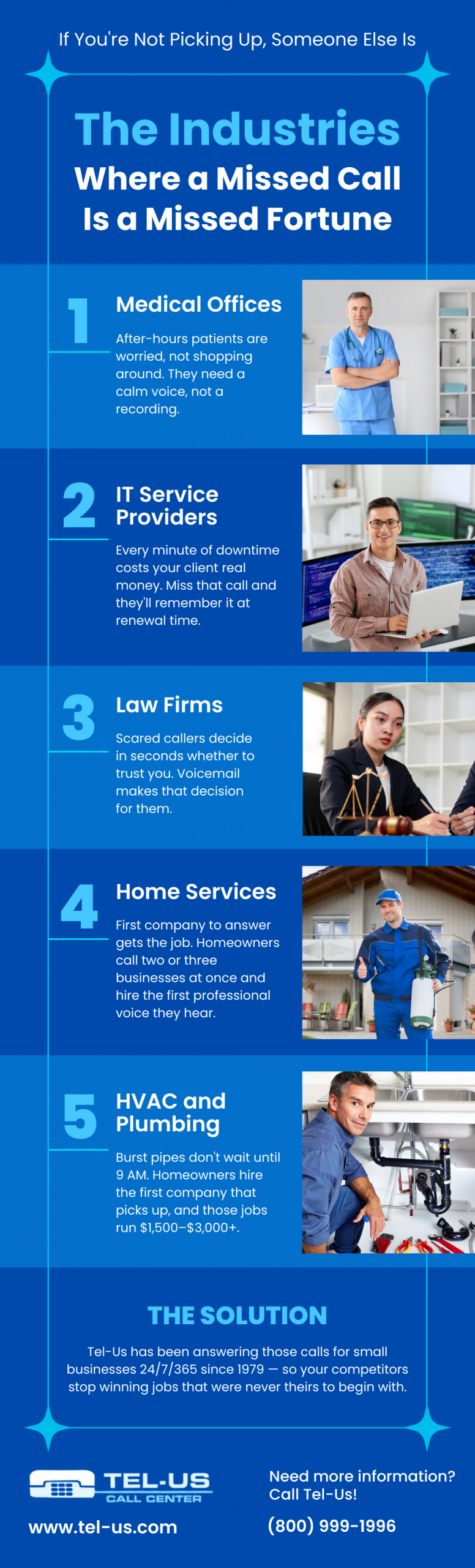
Law Firms
When a potential client calls a law firm after hours, they’re often in a vulnerable, stressful situation. Tel-Us agents are trained to use intake scripts that capture critical case information, express appropriate empathy, and qualify the lead — all while maintaining the professional tone your firm’s reputation demands. No “just leave a message.” Full intake, every time.
Real Estate
Leads go cold fast. Tel-Us captures buyer and seller inquiries around the clock, qualifies interest level, and schedules callbacks or showings directly into your calendar.

HVAC and Plumbing
Emergency dispatch is the whole game here. Tel-Us agents follow your specific on-call protocols to determine urgency, dispatch the right technician, and provide the caller with a realistic ETA. They know the difference between “the heat is acting up” and “there’s water coming through the ceiling” and they triage accordingly.
IT Service Providers
Your clients don’t call after hours because they want to chat. They call because something is down and every minute costs money. Tel-Us agents can follow tier-1 troubleshooting scripts, escalate to your on-call engineers, and document the issue in your ticketing system — all in a single call.
Medical and Healthcare
Patient calls require HIPAA-aware handling, compassionate tone, and accurate message taking. Tel-Us manages appointment requests, urgent symptom triage referrals, and after-hours nurse line coordination with the seriousness those calls deserve.
The reason this level of customization works is Tel-Us’s scripting and dispatching infrastructure — agents see your custom protocols the moment your dedicated number rings. It’s not magic. It’s just really well-built systems and 40-plus years of knowing what businesses actually need.
Features to Look For in a Premium Answering Service
Not all answering services are created equal. Here’s a quick comparison so you know exactly what you’re paying for when you go with a premium provider versus a basic message-taking operation:

Feature | Basic Message Taking | Tel-Us Premium Service |
Hours | Business hours only | 24/7/365 including holidays |
Agent type | General pool, no specialization | Trained, industry-specific agents |
Languages | English only | Bilingual English/Spanish |
Lead capture | Name and number | Full intake with custom scripting |
Appointment scheduling | No | Yes, directly into your calendar |
Emergency dispatch | No | Yes, with custom escalation protocols |
Spam/robocall filtering | No | Yes, via IVR screening |
AI-assisted tools | No | Yes, Human-in-the-Loop AI support |
Reporting and analytics | None | Real-time sentiment and call data |
Awards and accreditation | None listed | 14x ATSI, 13x CAM-X Award of Excellence |
The difference isn’t subtle. A basic message service does one thing — it records that someone called. A premium 24 hour answering service for small business like Tel-Us actually does business on your behalf.
Why Tel-Us Specifically? (The Short Version)
Tel-Us Call Center has been family-owned and operated since 1979. That’s not a marketing detail — that’s nearly five decades of showing up for small businesses before most of their current clients were born. Based in Los Angeles but serving businesses coast to coast, they’ve built a reputation that their awards reflect: 14 ATSI Awards of Excellence and 13 CAM-X Awards of Excellence, which are basically the Oscars of the call center world.
What makes them different isn’t just longevity. It’s the philosophy: “Tel-Us what you need, and we’ll build it.” Every protocol, every script, every dispatching rule is built around your specific business. Their bilingual English/Spanish agents mean you’re also capturing the significant portion of the U.S. market that prefers to do business in Spanish — a genuinely underserved advantage for small businesses in competitive markets.

If you want to explore what a customized 24 hour answering service for small business looks like for your specific situation, Tel-Us is at tel-us.com.
The Bottom Line
A 24 hour answering service for small business is one of the few investments you can make that pays for itself almost immediately — sometimes with a single phone call. The math is simple, the ROI is real, and the alternative (continuing to miss calls, burn out, and hand revenue to competitors) isn’t really an alternative at all.
If you’re running an HVAC company, a law firm, a medical practice, an IT shop, or honestly any general business where a ringing phone represents money and relationships, it’s time to stop being the person who can’t pick up. Let Tel-Us be that person instead. They’ve been doing it since before the internet existed, they’re really good at it, and they’ll customize everything to fit exactly how your business works.
Your Netflix queue will still be there. That $2,000 emergency call at 11:47 PM won’t wait.
Frequently Asked Questions
A 24-hour answering service for a small business typically costs between $100 and $400 per month, depending on call volume and whether the service bills per minute, per call, or on a flat-rate tier.
Yes, an after-hours answering service is highly cost-effective — capturing just one missed lead or emergency service call a month, such as a plumbing or HVAC job, often covers the entire monthly cost of the service.
Yes, professional answering services use IVR (Interactive Voice Response) prompts or live screening to filter out spam, robocalls, and telemarketers, ensuring you are only billed for legitimate customer interactions.
Yes, modern virtual receptionists and 24-hour answering services can integrate seamlessly with scheduling software to book, modify, or cancel appointments in real-time on your calendar.
Call center software automatically displays your customized business script, protocols, and company information on the agent's screen the moment your dedicated phone line rings.
AI answering services are faster for basic tasks and lower in cost, but live human receptionists remain superior for handling complex issues, expressing empathy, and closing high-value sales. A hybrid approach is best for 2026.
In an emergency, a 24-hour answering service follows your specific escalation protocol to immediately dispatch the call, page the on-call staff member, or patch the caller through to your mobile phone.
An answering service primarily handles inbound calls and takes messages, whereas a call center offers comprehensive business process outsourcing (BPO), including tier-1 tech support, order processing, and omnichannel customer service.
New Posts
-
14 Aug 2026The Strategic Blueprint: Choosing the Best Inbound Call Service Los Angeles
-
30 Jul 2026The $10,000 Ring: How Law Firm Telephone Answering Turns Missed Calls Into Signed Clients
-
20 Jul 2026Stop Leaking Leads: How a Contractor Answering Service Protects Every Job
-
29 Jun 2026The Strategic Blueprint to 24/7 Omnichannel Support: Choosing the Right 24/7 Call Center
Why Let Calls Go Unanswered?
Let us handle the calls, messages, and overflow support while your team focuses on the business.