The Strategic Blueprint to 24/7 Omnichannel Support: Choosing the Right 24/7 Call Center
Tel-Us Editorial Team
June 29, 2026
Let’s be honest. If your phone rings and nobody picks up, you’ve already lost something. Maybe it’s a sale. Maybe it’s a five-star review that’s never going to happen. Maybe it’s a client who just decided your competitor down the street is more reliable. Whatever it is, it’s gone the second that call goes to voicemail.
That’s the whole problem we’re here to solve. A 24/7 call center isn’t some bloated corporate luxury anymore — it’s the baseline expectation customers carry into every interaction with your business. We’re going to walk through exactly why that’s true, what it costs to ignore, and how a setup like ours at Tel-Us actually works behind the curtain.
Table of Contents
What Happens When Customers Can't Reach Your Business? The True Cost of a Missed Call
Picture this. Someone’s having a plumbing emergency at 9pm on a Friday. They call three places. Two go to voicemail. One picks up. Guess who gets the job, the five-star review, and the referral to their neighbor next month?
That’s not a hypothetical. That’s just how people behave now. We live in an instant-gratification world, and a missed call doesn’t just cost you one transaction — it costs you the next ten, because that frustrated caller tells people. They post about it. They leave a review with words like “never picked up” or “couldn’t get a hold of anyone,” and that review sits there forever, doing quiet damage to your brand every time someone Googles you.

There’s a psychological piece here too. When a business doesn’t answer, customers don’t think “oh, they’re probably just busy.” They think “this company doesn’t care about me.” That’s a brutal but accurate read of consumer psychology in 2026. Trust erodes fast and rebuilds slow. A single missed call rarely sinks a business on its own, but a pattern of missed calls absolutely will, one quiet cancellation and one un-posted referral at a time.
This is exactly the gap we built Tel-Us to close. Every account we run as a 24/7 call center is set up specifically so that moment — the ring nobody answers — simply doesn’t happen on our watch. We treat every incoming call as a brand moment, not just a transaction to process.
24/7 Call Center vs. Hiring an In-House Receptionist: A Comprehensive Financial Audit
Let’s talk numbers, because this is where the decision usually gets made.
A full-time, in-house receptionist costs you somewhere between $3,500 and $5,500 a month once you factor in salary, benefits, payroll taxes, and the desk and equipment they need to do the job. And what do you get for that? Coverage from roughly 9 to 5, Monday through Friday. Forty hours out of a 168-hour week. That means your business is unreachable almost 76% of the time.
Now stack that against an outsourced 24/7 call center like the one we run at Tel-Us. You’re not paying for a body in a chair eight hours a day — you’re paying for coverage scaled to your actual call volume. No benefits package. No sick days that leave your phones dead. No single point of failure when your one receptionist calls in sick or takes a vacation.

And overflow capacity is the other piece nobody talks about enough. An in-house receptionist can handle exactly one call at a time. If a second person calls while they’re on the line, that caller hits a busy signal or goes straight to voicemail. Our team handles concurrent calls without blinking, which means you’re never choosing between two customers.
Here’s the side-by-side so you can see it clearly:
Operational Vector | Full-Time In-House Receptionist | Outsourced Tel-Us 24/7 Call Center |
Coverage Window | Restricted to 40 Hours/Week (9 AM–5 PM) | Full 168 Hours/Week (Continuous 24/7/365) |
Average Monthly Cost | $3,500–$5,500 (Salary, Benefits, Taxes, Workspace) | Scalable Fraction of Overhead (Pay for Activity) |
Overflow Capacity | Absolute Zero (One call at a time; busy signals) | Infinite Simultaneous Concurrency (Scalable Agents) |
Holiday & Weekend Coverage | Requires Heavy Overtime Pay or Total Blackout | Standard Continuous Coverage Built Into SLA |
Technology Integration | Manual CRM entry, standard desk phones | Integrated AI Triage, Secure API Webhooks, Live Portal |
When you lay it out like this, the math isn’t even close. You’re paying more for less coverage, less flexibility, and zero redundancy. This is the exact comparison we walk new clients through during onboarding, because once they see the numbers side by side, the decision tends to make itself.
Hybrid 24/7 Call Center Infrastructure: Why AI + Live Agents Is the New 2026 Standard
Here’s where things get interesting. The old binary of “human receptionist” versus “robotic phone tree” is dead. What’s actually working right now is a hybrid model, and we built our entire 24/7 call center around it.
The idea is simple. Most calls coming into a business fall into two buckets. Bucket one is routine — checking an order status, confirming an appointment, asking for store hours. Bucket two is complicated, emotional, or high-stakes — a customer who’s upset, a complex troubleshooting issue, a sales conversation that needs a human touch.

A well-built hybrid system uses conversational AI to instantly handle bucket one. No hold music, no waiting in a queue for something that takes ten seconds to resolve. Our AI processes the request, pulls the relevant data, and either answers it directly or logs it into your system in real time.
The moment a call shows complexity, urgency, or emotional weight, it gets handed off immediately to one of our live agents, and that agent gets the full context the AI already gathered. No “can you repeat that” and no starting from zero. The customer feels like they’re talking to one continuous, competent operation — because with Tel-Us, they are.
This is what separates a modern 24/7 call center from an old-school answering service. It’s not AI replacing humans. It’s AI clearing the runway so our humans can spend their time where it actually matters.
Behind the Scenes: What Actually Happens Inside a 24/7 Call Center?
People imagine a call center as some chaotic room full of headsets and ringing phones. The reality, at least at Tel-Us, is a lot more disciplined than that.
Our agents go through structured training before they ever take a live call for a client. That means learning your business, your tone, your scripts, and your edge cases — not just reading off a generic template. Quality control runs continuously, not as a once-a-quarter audit. Calls get monitored, scored, and reviewed so issues get caught in days, not months.

The workspace itself is built around redundancy. Multiple agents are cross-trained on the same accounts so nobody on our team is ever a single point of failure for your business. Call flows are mapped out in advance — what happens if the caller wants X, what happens if they want Y, when does it escalate, when does it get logged and followed up on later. None of this is improvised at Tel-Us. It’s closer to an air traffic control system than a phone bank.
That structure is exactly why our clients tell us their callers don’t feel like they reached “a call center.” They feel like they reached the business itself.
The Anatomy of Overnight Infrastructure: How Calls Are Routed During Nights, Weekends, and Holidays
This is the part that genuinely impresses people once they understand it.
Our routing runs on cloud-based, geo-redundant systems. In plain terms, that means your calls aren’t dependent on one office, one server, or one location. If a storm knocks out power in one region, our system automatically reroutes to agents somewhere else, and the caller never even notices.
Automated Call Distribution, or ACD, is the engine behind this. The second a call comes in, our system checks the time, the day, your client profile, and any custom rules you’ve set with us, then routes it according to a pre-built script. Overnight, that might mean routing to our agents in a different time zone who are wide awake and ready. On a holiday, it might mean a specific greeting and a specific escalation path we’ve pre-built with you for true emergencies versus routine requests.
This is what “continuous operational fluidity” actually looks like in practice. It’s not magic, it’s architecture. But it’s architecture our clients never have to think about, which is exactly the point of working with a 24/7 call center built the right way.

2026 Customer Service Statistics Every Business Owner Must Know
A few numbers worth sitting with:
The 60-second threshold is real. Customers expect a response or a live routing within 60 seconds, and when that window gets blown, drop-off rates jump as high as 42%. People simply hang up and call the next name on the list. It’s a benchmark we hold our own average speed of answer against every single day.
Mobile is dominant. Over 78% of incoming customer interactions now start as mobile searches, which means click-to-call and instant messaging aren’t nice-to-haves anymore — they’re the front door to your business. That’s exactly why our setup is built around mobile-first channels from day one, not bolted on as an afterthought.
AI adoption has gone mainstream. More than 65% of support ecosystems are now running some form of conversational AI for basic tasks like order tracking and scheduling. We built our hybrid model around that shift early, rather than scrambling to retrofit it now.
Put those three numbers together and the picture is clear: speed, mobile accessibility, and smart automation aren’t optional anymore. They’re the price of entry, and they’re the standard we built our 24/7 call center to meet by default.
Evaluating Partners: 15 Critical Red Flags to Watch for When Selecting a Call Center Vendor
Not every call center is built the same, and picking the wrong one can do as much damage as having no coverage at all. Here’s what to watch for before you sign anything — and how we approach each one at Tel-Us:

Hidden telephony fees
Watch for unlisted per-minute rounding tricks or setup costs buried outside the main contract. We keep pricing transparent and spelled out before you ever sign.
No geo-redundancy
A lack of backup server nodes leaves your operations vulnerable during regional outages. Our infrastructure is built geo-dispersed from the ground up.
Absence of live dashboards
If a vendor can't show real-time SLA data, they're likely hiding poor performance. Every Tel-Us client gets real-time visibility, not a monthly PDF.
High agent turnover
Constant staff churn means your customers keep talking to someone new who doesn't know your business. We cross-train and retain agents specifically to avoid this.
Rigid contract terms
Long lock-ins with no flexibility to scale. We scale with you instead of locking you into terms that don't bend.
Lack of custom scripting
Generic, one-size-fits-all scripts that don't sound like your brand. Every script we run is built around your voice, not a template.
Poor security compliance
No HIPAA or PCI-DSS certification for industries that legally require it. We maintain both standards for clients who need them.
Slow escalation paths
Urgent calls sitting in a queue instead of reaching a live agent fast. Our hybrid AI-to-human handoff exists specifically to prevent this.
Opaque tier pricing
Pricing so complicated you can't predict your monthly bill. What you see in your Tel-Us agreement is what you pay.
No call recording access
You can't review how your customers are actually being treated. Our clients can review calls whenever they want.
Limited reporting
Vague monthly summaries instead of granular, actionable data. We provide detailed reporting clients actually use.
No integration support
A system that can't connect to your CRM or scheduling tools. We connect directly into the systems you already run.
Inflexible hours of coverage
"24/7" that quietly excludes holidays or has overnight gaps. Our 24/7 means all 168 hours, holidays included, no quiet exceptions.
Poor onboarding process
No real effort to learn your business before taking calls. Our onboarding is built around learning your operation first.
No quality assurance program
Calls that go unmonitored, with nobody catching mistakes. Every call we handle gets monitored and scored.
If a vendor checks more than two or three of these boxes, it’s worth walking away. The whole point of outsourcing to a 24/7 call center is peace of mind — not trading one headache for a different one.

Why Choose Tel-Us: What We Cover During Every 24-Hour Shift
This is usually the question that comes up once people understand the basic concept: okay, but what are your agents actually doing for me, hour by hour, all day and all night?
Fair question. Here’s what a full Tel-Us shift cycle typically includes for our clients.
24/7 live answering, around the clock
Every call gets picked up by a real agent or our conversational AI within seconds, whether it's 2pm on a Tuesday or 3am on a Sunday. There's no "after hours" voicemail box quietly collecting missed business.
Appointment scheduling and calendar management
Every call gets picked up by a real agent or our conversational AI within seconds, whether it's 2pm on a Tuesday or 3am on a Sunday. There's no "after hours" voicemail box quietly collecting missed business.
Message taking and intelligent call routing
Not every call needs a live transfer. Our agents capture detailed messages, flag priority level, and route to the right person or department based on rules you set, so urgent calls reach a decision-maker fast and routine ones get logged without interrupting anyone's day.
Emergency dispatch and urgent escalation
For industries where a missed call can mean a real emergency — property management, medical offices, HVAC, legal — our overnight team is trained on your specific escalation protocols, including when to call an on-call manager directly versus logging a message for the morning.

Order processing and customer account support
For e-commerce and retail clients, our agents handle order status checks, basic account questions, and returns processing, all integrated with your existing systems through secure API connections.
Bilingual and multilingual support
Depending on your client base, we staff agents who can handle calls in multiple languages, so language is never the reason a customer hangs up frustrated.
Lead capture and intake for sales teams
New inbound leads get qualified and logged in real time, with key details passed straight to your sales team so a hot lead at midnight doesn't go cold by the time someone checks email in the morning.
Holiday and disaster coverage
When your office is closed for a holiday or knocked offline by a storm, our geo-redundant network keeps answering. Your customers experience zero interruption even when your physical location is dark.
The throughline across all of it is this: we’re not just a phone-answering service bolted onto your business. We function as an extension of your team, trained on your specific protocols, available across every single hour your customers might call. That’s the actual difference between a generic answering service and a true 24/7 call center partner.
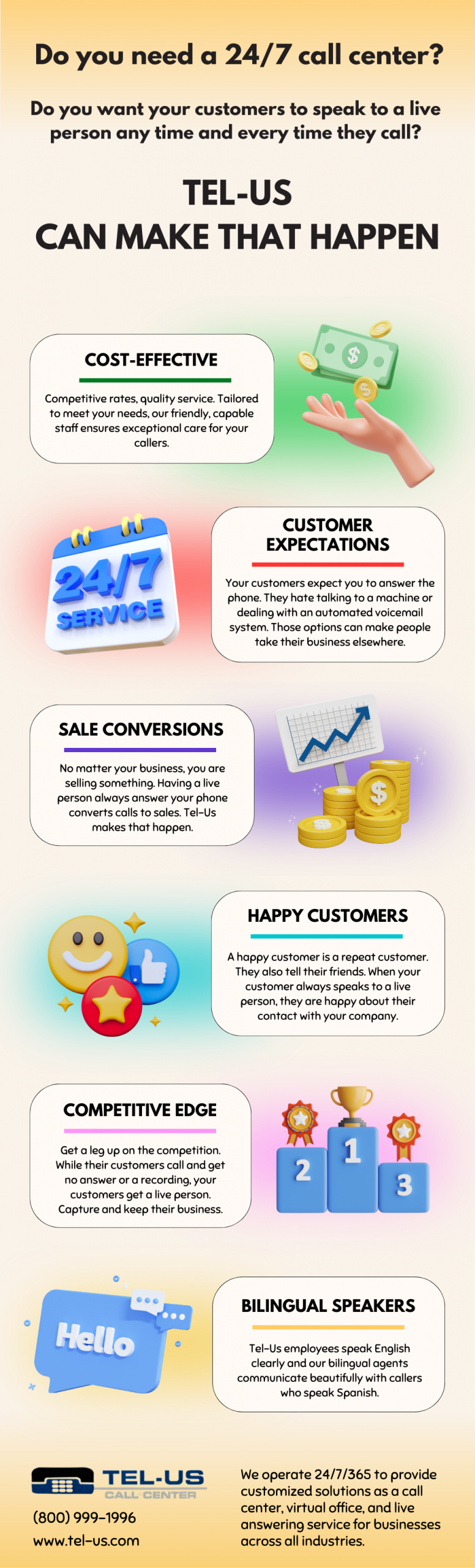
Frequently Asked Questions
A 24/7 call center is an externalized corporate communication solution that ensures a business remains accessible to its clients around the clock, every day of the year. With Tel-Us, that means capturing late-night leads, handling emergencies, eliminating busy signals, and projecting an enterprise-level brand image at a fraction of the cost of an internal team.
Outsourcing to a dedicated 24/7 call center is far more economical than maintaining an internal receptionist. A full-time receptionist requires a fixed salary, healthcare benefits, payroll taxes, and physical office space while covering just 40 hours a week. Tel-Us provides full 168-hour weekly availability, and you only pay for active time utilized.
Our hybrid model leverages automated conversational AI to instantly manage high-volume, repetitive inquiries — checking a balance, logging an order status, confirming an appointment. The moment a call requires complex troubleshooting or shows emotional urgency, the AI seamlessly hands the conversation, along with all collected context, to one of our live, professional human agents.
Missing incoming client interactions directly damages a company's financial health. A missed call drives a potential buyer straight to a competitor and often turns into a negative public review that permanently harms digital brand perception. Tel-Us exists specifically to make sure that scenario never plays out on your line.
Our inbound infrastructure runs on cloud-based, geo-redundant ACD frameworks. When a call comes in during a holiday, weekend, or overnight shift, the system instantly cross-references your client profile and executes pre-configured routing rules to direct the call to active, fully briefed Tel-Us agents — even across time zones.
Depending on your industry, a routing partner must adhere to rigorous standards. Legal and medical fields require strict HIPAA compliance, while e-commerce and retail need secure PCI-DSS compliance for payment handling. Tel-Us maintains both for the clients who need them.
Current consumer expectations dictate that wait times stay well under 60 seconds. We hold our own agents to that benchmark through strict workforce optimization and real-time scaling, keeping average speed of answer to a minimum.
Transitioning your communication setup is straightforward and requires zero infrastructure downtime. We provide tailored forwarding numbers and secure API webhooks — you simply coordinate with your phone provider to forward your primary lines or activate overflow rules directly through our onboarding portal at tel-us.com.
New Posts
-
14 Aug 2026The Strategic Blueprint: Choosing the Best Inbound Call Service Los Angeles
-
30 Jul 2026The $10,000 Ring: How Law Firm Telephone Answering Turns Missed Calls Into Signed Clients
-
20 Jul 2026Stop Leaking Leads: How a Contractor Answering Service Protects Every Job
-
29 Jun 2026The Strategic Blueprint to 24/7 Omnichannel Support: Choosing the Right 24/7 Call Center
Why Let Calls Go Unanswered?
Let us handle the calls, messages, and overflow support while your team focuses on the business.