
The Ultimate Guide to Hiring a Bilingual Answering Service Spanish English in 2026
admin
March 19, 2026
Let’s start with a scenario that might hit close to home. A potential customer calls your business. They speak Spanish. Nobody picks up who can help them. They hang up and call your competitor. You just lost a sale — and you didn’t even know it happened.
That’s not a hypothetical. It’s Tuesday for thousands of businesses across the U.S. right now.
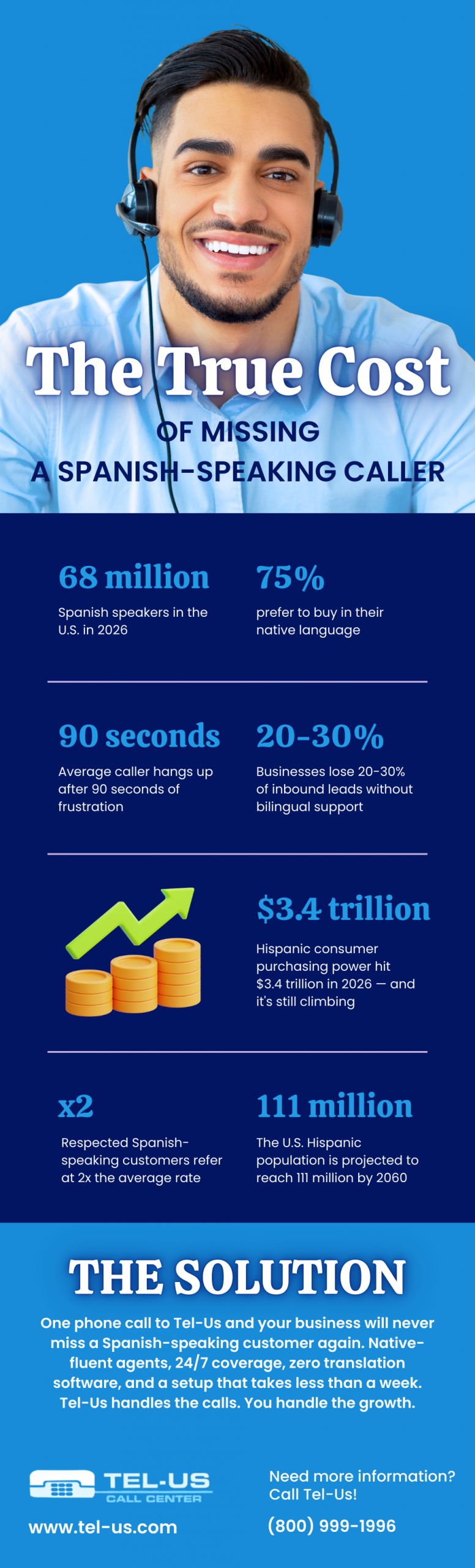
Here’s the thing: 68 million people in the United States speak Spanish at home. That’s roughly one in five Americans. The Hispanic consumer market is worth over $3.4 trillion in purchasing power as of 2026. And yet, so many businesses are still fumbling the most basic part — actually being able to talk to these customers. A professional bilingual answering service Spanish English isn’t a luxury anymore. It’s table stakes.
So let’s dig into everything you need to know about getting this right, how Tel-Us makes it look effortless, and why 2026 is honestly the best — and most urgent — time to make the switch.
Table of Contents
Why Your Business Needs a Bilingual Answering Service Spanish English in 2026
Okay, let’s talk money, because that’s really what this comes down to.
The U.S. Hispanic population has grown by over 23% in the last decade. In states like California, Texas, Florida, New Mexico, and Arizona, Spanish is genuinely the dominant language in entire neighborhoods, industries, and professional networks. But this isn’t just a regional story anymore. Cities like Chicago, New York, and even smaller metros in the Midwest and Southeast are seeing rapid growth in Spanish-speaking communities.
Here’s a fun (and slightly alarming) stat: studies show that 75% of Spanish-speaking consumers prefer to buy products and services in Spanish. Not because they can’t speak English — plenty of them can — but because being addressed in your native language builds instant trust. It signals that a business actually sees you and respects you. That’s a psychological trigger that no amount of clever marketing can manufacture.

When a caller dials your business and immediately hits a wall — nobody speaks Spanish, the hold music plays, the frustration builds — they don’t wait around. They hang up within 90 seconds on average and call someone else. Every one of those calls is a lead walking straight to your competition.
A bilingual answering service Spanish English plugs that leak completely. Every call gets answered, every caller feels heard, and your business captures revenue it was invisibly leaving on the table.
Top 2026 Trends in Bilingual Customer Experience
This space is evolving fast, and the businesses winning right now are the ones who understand where things are headed. Three trends are defining bilingual customer support in 2026, and they’re genuinely exciting.
AI-Enhanced Human Empathy is the big one. Here’s the deal — AI is finally good at the routing and sorting work. When someone calls, an AI system can instantly detect language preference from IVR selections or even voice recognition, and get that caller to the right human agent in under 10 seconds. That’s great. But here’s where smart businesses draw the line: AI handles the logistics, humans handle the conversation. Complex, emotional, or sensitive calls — a patient asking about a medical bill, a family calling about legal paperwork — need a real person who can feel the weight of the moment. Tel-Us uses AI-powered answering service to make sure Spanish-speaking callers never wait unnecessarily, while keeping genuine human empathy front and center where it matters most.

Hyper-Local Cultural Nuance is the trend that most businesses completely overlook, and it’s actually kind of fascinating. “Spanish” isn’t one thing. Mexican Spanish, Puerto Rican Spanish, Cuban Spanish, Colombian Spanish — these aren’t just accent differences. They involve different vocabulary, different idioms, different cultural references, and different communication styles. Calling someone “tú” versus “usted” in the wrong context can feel rude or weirdly formal depending on where the caller is from. A bilingual answering service Spanish English that trains agents in regional dialect awareness is operating at a completely different level from one that just hired someone who took four years of high school Spanish. Tel-Us agents are trained specifically in these cultural distinctions, which means callers feel like they’re talking to someone who genuinely gets them.
Omnichannel Bilingual Support is the third trend reshaping expectations in 2026. Customers don’t just call anymore. They text. They chat. They send messages through web portals. A modern bilingual answering service Spanish English needs to handle all of these touchpoints in both languages, seamlessly. Tel-Us integrates phone, SMS, and secure web chat into one unified workflow, so whether your customer calls at 2pm or texts at midnight, they get the same quality of bilingual support. No dropped threads, no “please call us during business hours,” no communication dead zones. Learn more about our web-chat, text, email answering services

How Bilingual Call Routing Works Behind the Scenes
People assume this is complicated. It’s actually pretty elegant once you see it laid out. Here’s the basic flow of how a great bilingual answering service Spanish English handles an inbound call:
A customer dials your business number. That number is forwarded to Tel-Us’s system. An AI-powered Automatic Call Distribution (ACD) system activates immediately. The caller hears a brief IVR prompt — “For English, press 1. Para Español, oprima 2.” The selection is logged instantly and the call is routed to an available agent fluent in that language. The agent answers with your custom greeting, in the caller’s chosen language, usually within two to three rings.
The whole handoff takes seconds. The caller experiences zero friction. From their perspective, they just called your business and someone helpful answered in their language. That’s the magic of a well-built bilingual answering service Spanish English — it’s invisible infrastructure that makes your business look seamlessly professional.
Behind the scenes, there’s also real-time monitoring, call recording for quality assurance, detailed call logs in both languages, and escalation protocols for urgent situations. Nothing falls through the cracks.

In-House vs. Outsourced: A Cost-Benefit Analysis
Everyone wants to compare the math here, so let’s actually do it properly.
Factor | Hiring Bilingual In-House Staff | Tel-Us Bilingual Answering Service |
Cost | $45,000–$65,000 per year per agent, plus benefits, taxes, and HR overhead | Flexible per-minute or monthly plans starting significantly lower, no overhead |
24/7 Coverage | Requires multiple hires and complex shift scheduling, expensive to sustain | Fully covered, 365 days a year including holidays, zero gaps |
Scalability | Slow — hiring and training takes months | Instant — scale up or down based on call volume with no delays |
Training | Your responsibility — time-consuming, costly, and ongoing | Fully handled by Tel-Us including language, culture, compliance, and your business protocols |
Tech Stack | You buy and maintain your own phone system, IVR, and recording tools | Included in your service — enterprise-grade technology at no extra cost to you |
The math isn’t even close. A single full-time bilingual in-house hire with benefits and overhead easily clears $70,000 per year, covers one shift, takes sick days, and needs retraining when your scripts change. A bilingual answering service Spanish English from Tel-Us gives you a full team, round the clock, with built-in technology and compliance baked in — for a fraction of that cost.

The 5 Key Industries That Must Offer Spanish and English Support
Medical Practices and Healthcare Providers
Medical Practices and Healthcare -this one’s personal. When a patient can’t communicate their symptoms clearly, or misunderstands a follow-up instruction, it’s not just a bad customer experience — it can be genuinely dangerous. Spanish-speaking patients who can’t easily communicate with their provider’s office delay care, miss appointments, and disengage from treatment plans. A HIPAA-compliant bilingual answering service Spanish English means every patient call is handled with accuracy, sensitivity, and full regulatory compliance. Tel-Us agents are trained specifically for healthcare settings.
Legal Firms and Immigration Attorneys
Legal matters are high-stakes and deeply stressful. When a Spanish-speaking client calls a law firm and can’t make themselves understood, they don’t try again — they find a different attorney. Immigration law in particular serves an enormous Spanish-speaking population that needs precise, culturally sensitive communication. A bilingual answering service Spanish English here directly translates to client retention and signed retainers.
Real Estate Agencies
Spanish-speaking homebuyers represent one of the fastest-growing segments of the U.S. real estate market. A caller who can’t get answers about a listing in their preferred language moves on immediately. Real estate runs on responsiveness, and a bilingual answering service Spanish English that captures leads at 9pm on a Sunday can directly impact your closing rate.

Home Services Companies
Contractors and service providers — a huge portion of service calls in major metros come from Spanish-speaking households. These are often urgent calls. A burst pipe doesn’t wait for a bilingual staff member to come in on Monday morning. 24/7 bilingual coverage means you capture emergency service calls that competitors miss entirely.
E-commerce and Retail
Customer service is the differentiator in e-commerce. Returns, order questions, shipping issues — Spanish-speaking customers who get fast, friendly help in their language become loyal repeat buyers. And they tell their community. Word-of-mouth in tight-knit Spanish-speaking communities is enormously powerful, and excellent bilingual service is one of the fastest ways to earn it.
4 Immediate ROI Boosts from Bilingual Support
Increased Lead Capture
Every call that previously ended in frustration and a hang-up now converts into a logged lead, a booked appointment, or a sale. Businesses report capturing 20-30% more inbound leads within the first 90 days of adding bilingual answering service Spanish English coverage.
Reduced Abandoned Calls
Abandonment rates drop dramatically when callers are immediately greeted in their preferred language. A caller who feels understood within the first 10 seconds doesn't hang up.
Higher Customer Retention
Customers who can communicate easily stay longer. It sounds simple because it is. Retention rates among Spanish-speaking customers improve measurably when businesses invest in genuinely bilingual support infrastructure.
Better Online Reviews
Happy customers who felt respected and understood are significantly more likely to leave 5-star reviews — and they often specifically mention the bilingual experience as a reason. This feeds directly into your local SEO and reputation management.

Overcoming the "Translation Trap": Why Cultural Nuance Matters
Here’s where we need to get a little philosophical for a second, because this is genuinely important and widely misunderstood.
Most businesses that think they’ve “solved” the bilingual problem have actually just installed a layer of Google Translate on their call handling and called it a day. This is almost worse than nothing. Automated translation software handles literal word conversion. It does not handle tone, context, idiom, regional phrasing, emotional register, or the dozen subtle ways that a conversation can go sideways.
Here’s a real example of why this matters. In some Latin American dialects, certain phrases that are completely neutral in one country carry entirely different connotations in another. A script that was written with Mexican-American callers in mind might feel off to a caller from the Dominican Republic, not because anything is factually wrong, but because the phrasing, the formality level, and the conversational rhythm feel foreign and impersonal.
When a caller notices — and they always notice — that the “bilingual service” they reached is clearly operating from a script or a translation tool, the trust evaporates. They don’t feel like a valued customer. They feel like an afterthought. And the brand damage is real.
A bilingual answering service Spanish English built on native-fluency human agents sidesteps this entirely. There’s no translation lag, no awkward phrasing, no cultural missteps. Just a natural, fluent conversation with someone who genuinely speaks their language in every sense of the phrase.

How Tel-Us Delivers Flawless Bilingual Communication 24/7
So what does this actually look like when you sign on with Tel-Us? Let’s walk through it.
Onboarding is fast and collaborative. When you start with Tel-Us, you work directly with our team to build a custom call script in both English and Spanish that matches your brand voice, handles your most common call types, and includes escalation protocols for complex situations. This isn’t a generic template — it’s built around how your business actually operates.
Agent training goes beyond language proficiency. Tel-Us agents are trained on your specific industry, your product or service offerings, your geographic market, and the cultural profile of your typical Spanish-speaking caller base. A medical practice in South Texas has different needs than a real estate agency in Miami, and our training reflects that.
Technology ties it all together. Our AI-powered call routing ensures Spanish-speaking callers reach Spanish-fluent agents immediately, every time. Call recordings, real-time monitoring, and detailed multilingual call logs give you full visibility into every interaction. And our omnichannel capability means we’re not just answering phones — we’re handling SMS and web chat in both languages as well, through one unified platform.
The result is a bilingual answering service Spanish English that feels completely native to your business. Your callers have no idea they’ve reached an outsourced team. They just know that when they called, someone helpful and friendly answered in their language, handled their needs, and made them feel like a valued customer. That’s the Tel-Us experience.
The bottom line is this: the U.S. market is bilingual whether your business is ready or not. Every day you operate without a bilingual answering service Spanish English is a day you’re handing revenue to competitors who figured this out before you. Tel-Us makes the transition fast, affordable, and genuinely seamless — so your business captures every lead, serves every caller, and builds the kind of cross-cultural trust that turns first-time callers into loyal long-term customers.
Ready to stop losing Spanish-speaking leads? Visit tel-us.com and let’s talk about what a bilingual answering service Spanish English can do for your bottom line.
Frequently Asked Questions
A bilingual answering service is a remote call center solution where live agents answer inbound calls fluently in two languages, most commonly Spanish and English, on behalf of a business. Unlike automated translation tools, a true bilingual answering service Spanish English employs native or fully fluent agents who can handle complex conversations, emotional calls, and industry-specific terminology with accuracy and cultural sensitivity. Businesses contract these services to ensure all callers are served professionally regardless of language preference.
Pricing varies by provider and call volume, but most bilingual answering service Spanish English providers in 2026 structure plans in one of three ways: per-minute billing (typically $0.85–$1.40 per minute), per-call billing (roughly $5–$12 per call depending on complexity), or flat monthly packages starting around $250–$400 per month for small to mid-volume businesses. These rates represent significant savings compared to hiring in-house bilingual staff, which typically costs $45,000–$65,000 annually per agent before benefits and overhead.
Yes. A professional bilingual answering service Spanish English operates 24 hours a day, 7 days a week, 365 days a year including holidays. This is one of the primary advantages over in-house staffing. Tel-Us provides uninterrupted coverage so Spanish and English-speaking callers always reach a live human agent regardless of when they call.
Advanced answering services use IVR (Interactive Voice Response) prompts — for example, "For English, press 1. Para Español, oprima 2" — to instantly route the call to an agent fluent in that language. In 2026, many providers including Tel-Us also use AI-powered voice recognition to detect language preference before the prompt even completes, enabling faster and more seamless routing. The entire process takes under 10 seconds from dial to live agent.
Yes. Appointment scheduling is one of the most common and valuable functions of a bilingual answering service Spanish English. Agents can access your scheduling platform in real time, book, modify, or cancel appointments in both languages, send confirmation details to callers via SMS, and follow any specific scheduling protocols your business requires. This is particularly valuable for medical practices and legal offices with high Spanish-speaking patient or client volumes.
Yes, reputable providers like Tel-Us maintain full HIPAA compliance for medical clients. This includes agent confidentiality training, secure call recording protocols, encrypted data handling, and signed Business Associate Agreements (BAAs) as required by federal law. A bilingual answering service Spanish English serving healthcare clients must meet these standards in both language channels, and Tel-Us's medical-specific training ensures every Spanish and English call is handled to the same compliance standard.
No. Premium bilingual answering services employ native or fully fluent bilingual agents to ensure cultural nuance and immediate comprehension without the lag or inaccuracy of translation software. Real-time translation tools introduce delays, produce awkward phrasing, and miss cultural context entirely. Tel-Us agents speak Spanish and English naturally and fluently, without any software mediation, which is why callers experience the conversation as natural, warm, and trustworthy.
Most businesses are fully operational with Tel-Us within 3 to 7 business days. The setup process includes a discovery call to understand your business, custom script development in both English and Spanish, agent briefing on your industry and protocols, and technical call forwarding configuration. Urgent situations can sometimes be accommodated faster. Once active, your bilingual answering service Spanish English is live 24/7 from day one with no ramp-up period required.
New Posts
-
14 Aug 2026The Strategic Blueprint: Choosing the Best Inbound Call Service Los Angeles
-
30 Jul 2026The $10,000 Ring: How Law Firm Telephone Answering Turns Missed Calls Into Signed Clients
-
20 Jul 2026Stop Leaking Leads: How a Contractor Answering Service Protects Every Job
-
29 Jun 2026The Strategic Blueprint to 24/7 Omnichannel Support: Choosing the Right 24/7 Call Center
Why Let Calls Go Unanswered?
Let us handle the calls, messages, and overflow support while your team focuses on the business.