The $10,000 Ring: How Law Firm Telephone Answering Turns Missed Calls Into Signed Clients
Tel-Us Editorial Team
July 30, 2026
It’s 11:47 PM on a Tuesday. Somewhere in your city, a woman just left a house she can no longer safely stay in. A father just got a call that his son was arrested three hours ago. A small business owner just got blindsided by a wrongful termination claim and can’t sleep. Each of them does the exact same thing: they pick up their phone and start calling attorneys.
The first firm that answers with a real, calm, competent human voice usually wins that client. The rest lose them to a competitor, a voicemail box, or worse — a Google search that ends somewhere else entirely.
This is the reality of modern legal marketing, and it’s why law firm telephone answering has quietly become one of the most important growth levers a law firm can pull. Not the flashiest. Not the most talked-about at bar association mixers. But arguably the one with the most direct line to your bottom line.
This guide breaks down exactly why that’s true, what a great intake process looks like, and how firms are using a dedicated law firm telephone answering service to convert more callers into signed clients — without hiring a single additional employee.
Table of Contents
The High Cost of Silence: Why Law Firm Telephone Answering Is Critical for Growth
Let’s start with an uncomfortable truth: most law firms are losing winnable cases before an attorney ever says a word. Not because of bad marketing. Not because of weak case value. Because of silence on the other end of the phone.
The First-Responder Advantage
People don’t shop for lawyers the way they shop for shoes. When someone is dealing with a personal injury, a criminal charge, or a family emergency, they are operating from a place of fear, urgency, and adrenaline. They are not methodically comparing five firms’ websites over a cup of coffee. They are calling numbers, one after another, until someone answers.

This is the single most important dynamic in legal client acquisition: the first firm to answer the phone with a live human voice is overwhelmingly likely to be the firm that gets hired. It doesn’t matter if your firm has better reviews, more experience, or a bigger settlement history. If the phone rings four times and rolls to voicemail, that prospective client has already dialed the next name on their list before your ringback tone even ends.
Reliable law firm telephone answering isn’t a “nice to have” administrative convenience. It’s a front-line acquisition strategy.
The Economics of Missed Consultations
Do the math on this for a second. If your firm handles personal injury, employment law, or any practice area with meaningful contingency or retainer value, a single missed call can represent a five-figure loss. Multiply that by the number of after-hours calls, lunch-hour calls, and Friday-afternoon calls your firm misses every single month, and the number becomes genuinely staggering.
Most firms have no idea how much revenue is leaking out through unanswered calls, because a missed call doesn’t show up on a P&L statement. It just quietly disappears — along with the client who eventually signed with someone else.
Building Trust at First Contact
There’s also a softer, but equally powerful, factor: trust. A prospective client’s very first interaction with your firm sets the emotional tone for the entire relationship. When that first contact is a warm, professional, immediately-responsive voice — instead of a cold voicemail greeting — it signals competence, reliability, and care before an attorney has said a single word.
Compassionate, well-trained call handling reduces caller anxiety and builds the kind of early trust that makes someone comfortable enough to actually retain your firm, rather than hanging up to “think about it” and never calling back.

Streamlining Intake: How a Dedicated Law Firm Telephone Answering Service Elevates Conversion
Answering the phone is step one. What happens in the next ninety seconds of that call is where cases are actually won or lost. A well-designed law firm telephone answering service does far more than just pick up — it runs a structured, repeatable intake process that turns a raw caller into a qualified, scheduled lead.
Here’s what that structure typically includes:
Tailored Call Screening
Filtering out robocalls, vendor solicitations, and clearly unqualified inquiries so your attorneys spend their limited hours on billable, case-worthy conversations instead of noise.
Custom Lead Capture
Collecting the specific details your firm actually needs: incident dates, injury type, contact information, and case background, captured precisely to your firm's intake standards rather than a generic script.
Preliminary Conflict-Check Questions
Gathering the names of involved parties and adverse parties upfront, so potential conflicts of interest are flagged before an attorney ever gets pulled into a call they shouldn't be on.
Direct Urgent Routing
Recognizing true emergencies — a jail hold, an urgent injunction, a severe accident — and immediately escalating those calls to the on-call attorney instead of leaving them in a standard callback queue.
Real-Time Consultation Booking
Locking in qualified leads directly onto attorney calendars while their interest and urgency are at their peak, rather than promising a "callback within 24 hours" and hoping they don't call the next firm in the meantime.
This is the operational backbone of a good legal intake call center, and it’s exactly the kind of workflow that a dedicated law firm telephone answering service, like Tel-Us, builds and executes on your behalf.

Capturing Broader Demographics: The Power of Bilingual Legal Answering
If your firm only answers calls in English, you are almost certainly leaving business on the table.
Reaching Spanish-Speaking Communities
Spanish-speaking communities represent a massive and growing share of the legal services market in the United States, particularly in practice areas like personal injury, immigration, and family law. Firms that offer fluent, culturally competent Spanish-language intake have a significant competitive edge over firms that don’t — simply because they’re able to say “yes, we can help you” to a much larger pool of prospective clients.
Eliminating Language Barriers in Emergencies
This matters even more in high-stress situations. Automated translation apps and choppy call-center scripts fall apart fast when a caller is panicked, speaking quickly, or describing something emotionally complex like a family crisis or a serious accident. Live, professionally trained bilingual specialists can navigate that nuance in real time — something automated tools simply cannot replicate when it counts most.

Expanding Total Addressable Market
Once a firm has confidence in its bilingual intake capability, it opens the door to running targeted Spanish-language advertising campaigns without worrying about what happens when those calls actually come in. Your marketing spend only pays off if the person who calls gets a real, competent answer — bilingual law firm telephone answering makes that possible around the clock.
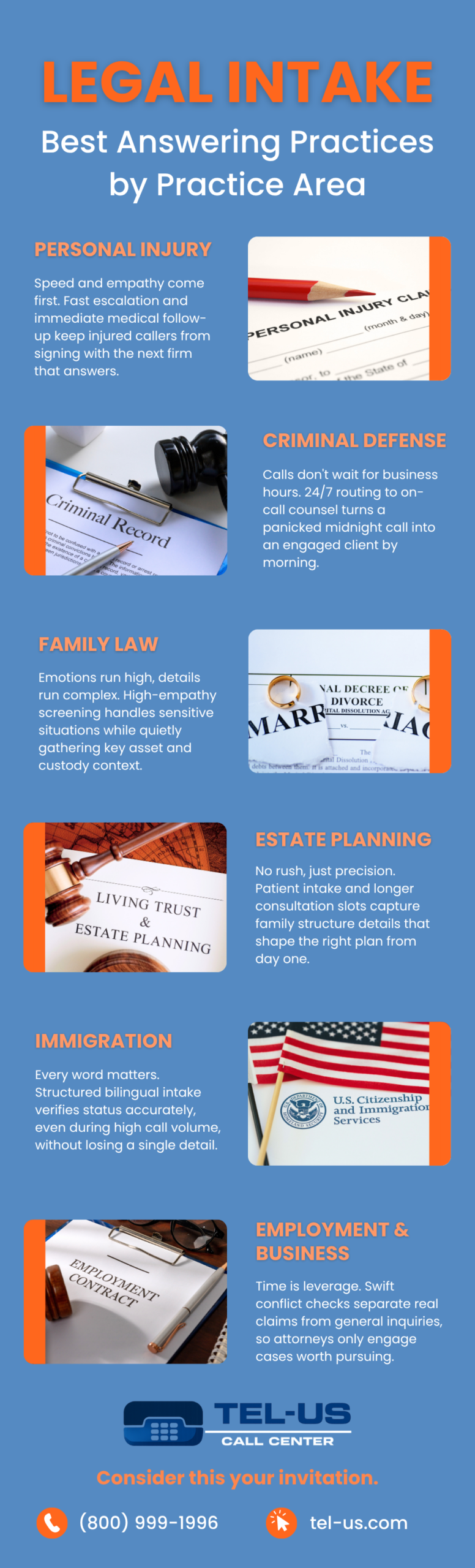
Tailored Workflows: Legal Intake Best Practices by Practice Area
Not every legal call should be handled the same way. A great law firm telephone answering service adapts its approach based on practice area:
Personal Injury Law
Prioritizes immediate empathy, asks about injury severity and current medical treatment status, and escalates quickly to prevent the caller from losing momentum and signing with another firm.
Criminal Defense Law
Handles frantic after-hours calls with a calm, structured approach: gathering detention details, setting clear expectations, and routing urgent matters to on-call counsel any hour of the day or night.
Family Law & Divorce
Uses a high-empathy approach for emotionally charged conversations, while carefully screening for complex marital asset and custody context.

Estate Planning & Probate
Approaches inquiries with patience, schedules appropriately longer initial consultation blocks, and captures relevant family structure details upfront.
Employment & Business Law
Runs swift preliminary conflict checks and distinguishes genuinely actionable claims from general inquiries that don't warrant attorney time.
Immigration Law
Delivers structured bilingual intake, verifies visa or status type early in the call, and manages high call volume efficiently without sacrificing accuracy.
Practice-area-specific intake isn’t a luxury — it’s what separates a generic call center from a true legal answering partner.
Confidentiality, Ethics, and Compliance in Virtual Answering
Attorneys don’t get the luxury of treating client communication casually, and neither should the team answering their phones.
Attorney-Client Sensitivity
Every operator handling calls for a law firm needs to be trained specifically in privacy, non-disclosure, and discretion — treating every call as if it could involve sensitive, privileged information, because often, it does.
Data Security Standards
Message delivery matters just as much as the conversation itself. Secure transmission methods — encrypted SMS, secure email, or direct entry into your firm’s CRM — protect client information in a way that plain, unencrypted text messages simply cannot.

Preventing Unauthorized Practice of Law (UPL)
Perhaps most critically, operators must be rigorously trained to never offer legal advice or opinions of any kind. Scripts need firm, well-defined boundaries that keep every call safely within the lines of intake and scheduling — protecting both the caller and the firm from unauthorized practice of law concerns.
In-House Receptionist vs. Outsourced Law Firm Telephone Answering Service
For many firms, the real decision isn’t whether to invest in better call handling — it’s how. Here’s how the two most common approaches stack up:
Operational Metric | In-House Receptionist | Tel-Us Legal Answering Service |
Hours of Coverage | Standard 8 AM – 5 PM (excludes nights & weekends) | 24/7/365 continuous live coverage |
Cost Structure | High fixed salary + benefits, taxes, & equipment | Scalable pay-for-usage or predictable monthly plans |
Overflow & Peak Handling | Limited to 1–2 phone lines; callers get busy signals | Unlimited rollover capacity; zero caller hold times |
Bilingual Availability | Depends on specific individual employee skills | On-demand English & Spanish specialist teams |
Reliability & Redundancy | Vulnerable to sick leave, vacation, & turnover | Guaranteed uptime with redundant call-center infrastructure |

An in-house receptionist is a fine solution for daytime, low-volume coverage. But the moment a firm needs true 24/7 reliability, multilingual capacity, or overflow protection, outsourced law firm telephone answering becomes the more resilient, cost-predictable option — without the overhead of a full-time hire.
Modern Practice Management: Calendar Sync and Tech Stack Integration
A great answering service shouldn’t operate as a disconnected silo — it should plug directly into how your firm already works.
Direct Software Connectivity
Tel-Us integrates directly with the legal software tools firms already rely on daily, including Clio, PracticePanther, LawPay, Calendly, and MyCase — so new leads flow straight into your existing systems instead of sitting in a separate inbox waiting to be manually entered.
Eliminating Administrative Bottlenecks
That integration matters more than it might seem. Every manual step between “call answered” and “lead entered into the system” is a place where information gets delayed, forgotten, or lost. Automating that handoff saves meaningful administrative hours every single week — hours your staff can redirect toward higher-value work.
Data Accuracy
Direct data transfer also means fewer transcription errors, fewer dropped details, and a cleaner, more reliable intake pipeline overall — which ultimately means fewer leads falling through the cracks.

2026 Legal Answering & Intake Trends
The bar for responsiveness keeps rising, and firms that don’t keep pace are handing business to competitors who do.
- Hyper-Speed Lead Response Expectations — In 2026, legal consumers expect to be connected in under 30 seconds. Delays beyond two minutes are associated with an 80%+ drop in lead conversion.
- AI-Assisted, Live-Human Hybrid Workflows — Leading firms are pairing instant AI-powered CRM lookups with genuine human empathy during intake — combining speed with the warmth that automated systems alone can’t deliver.
- Omnichannel Intake Synchronization — Phone intake is increasingly synchronized with web-form follow-ups, SMS text-back confirmations, and real-time calendar locks, creating a seamless experience across every touchpoint.
Law Firm Phone Efficiency Tips
- Implement Dynamic Call Routing Rules — Route high-value practice area calls (like severe injury cases) directly to senior intake specialists, while general inquiries follow a standard booking path.
- Establish a 5-Minute Callback SLA — When an after-hours caller requests an attorney callback, make sure your on-call alert system reaches that attorney fast enough to meet a tight response window.
- Audit Intake Scripts Quarterly — Regularly revisit and update your screening questions to reflect evolving firm goals, active marketing campaigns, or shifting fee structures.

The Bottom Line
Every missed call is a missed client. Every after-hours voicemail is a prospective retainer walking straight into a competitor’s office. In a legal market where response speed determines who gets hired, reliable law firm telephone answering isn’t a back-office convenience — it’s a growth engine.
Tel-Us gives law firms 24/7/365 live coverage, bilingual intake, practice-area-specific screening, real-time calendar booking, and airtight confidentiality — all without the cost or fragility of expanding in-house staff. If your firm is ready to stop losing cases to silence, explore Tel-Us’s legal answering solutions and get a quote today.
Frequently Asked Questions
Yes. Over 35% of legal inquiries come in outside standard business hours, and prospective clients facing emergencies — arrests, accidents, sudden family disputes — overwhelmingly hire the first attorney who offers immediate live communication.
Yes. A professional law firm telephone answering service integrates directly with major calendar and legal management platforms like Clio, Calendly, and Outlook, qualifying callers and booking consultations in real time based on your firm's availability.
Yes. Legal answering services train operators in strict privacy protocols, follow rigid scripts that avoid the unauthorized practice of law, and use encrypted communication channels to transmit intake notes securely.
Unlike a full-time in-house receptionist, which involves salary, benefits, and office overhead, an outsourced service typically runs on scalable per-minute or per-call plans — delivering 24/7 coverage at a fraction of the cost of one full-time employee.
Yes. Advanced workflows allow for custom emergency escalation, where operators identify urgent matters — like active jail bookings or serious injuries — and immediately transfer the caller to the on-call attorney's mobile phone.
Absolutely. Every firm receives a fully customized call flow, with qualification questions, screening criteria, conflict-check procedures, and tone dictated entirely by the firm itself.
Yes. Tel-Us offers dedicated bilingual English and Spanish answering, helping firms capture leads and serve non-English-speaking clients in key markets without communication gaps.
Caller overflow is handled seamlessly by a team-based service. Unlike an in-house receptionist limited to one call at a time, an answering service provides multi-line redundancy so no prospective client ever hits a busy signal or gets sent to voicemail.
New Posts
-
14 Aug 2026The Strategic Blueprint: Choosing the Best Inbound Call Service Los Angeles
-
30 Jul 2026The $10,000 Ring: How Law Firm Telephone Answering Turns Missed Calls Into Signed Clients
-
20 Jul 2026Stop Leaking Leads: How a Contractor Answering Service Protects Every Job
-
29 Jun 2026The Strategic Blueprint to 24/7 Omnichannel Support: Choosing the Right 24/7 Call Center
Why Let Calls Go Unanswered?
Let us handle the calls, messages, and overflow support while your team focuses on the business.